

Next.js vs. React for SaaS MVP: The Founder’s Tech Stack Decision Framework
Every technical founder and CTO building an early-stage software company hits the same fork in the road during sprint zero: What is our frontend foundation?
When choosing between Next.js vs React for SaaS MVP development, the decision is rarely just about developer ergonomics or personal syntax preferences. It is a high-stakes business calculation. The architecture you pick determines how fast your engineering team ships features, how much runway you burn on cloud infrastructure, whether your public pages can be discovered by search engines and AI models, and whether you will face a painful, six-figure codebase rewrite eighteen months from now.
If you choose a standalone React Single Page Application (SPA), you get complete architectural freedom, simple static hosting, and minimal server overhead. If you choose Next.js, you get a full-stack framework with built-in server-side rendering (SSR), optimized asset pipelines, and an opinionated structure that accelerates time-to-market.
Both approaches are viable, but they serve fundamentally different SaaS distribution models.
Here is an architectural and financial breakdown of how React and Next.js compare for early-stage SaaS MVPs—and how to make the right stack decision based on your go-to-market strategy.
The Core Distinction: UI Library vs. Opinionated Meta-Framework
Before evaluating trade-offs, we need to clarify what we are comparing.
| ARCHITECTURAL SCOPE | |
| Standalone React (e.g., Vite SPA) | Next.js (Full-Stack Meta-Framework) |
| UI Component Library only | UI Library (React) built-in |
| You choose routing (React Router) | File-system routing (App Router) |
| You configure build tooling | Zero-config bundler (Turbopack) |
| Client-side rendering (CSR) | Hybrid rendering (SSR, SSG, RSC) |
| Requires external backend/API | Built-in API routes & Server Actions |
React is a declarative UI library. It governs how state translates into visual components on a screen. On its own, React does not dictate how your application handles URL routing, how data is fetched during build time, or how HTML is rendered to a browser. You build your own custom framework by assembling third-party packages around it. If you want to review the underlying mechanics of React’s component model, see our breakdown on Internal link: React JS: The Powerhouse Behind Modern Web Experiences.
Next.js is an open-source React meta-framework maintained by Vercel. It takes the core React library and wraps it in a complete, production-ready environment. It provides file-based routing, server-side data fetching, automatic image and font optimization, API endpoints, and hybrid rendering capabilities straight out of the box.
When building a React MVP development pipeline, you are not choosing between React and Next.js in terms of syntax—Next.js is React. You are deciding whether you want an unopinionated client-side library where you configure the infrastructure yourself, or an opinionated full-stack framework that manages the server and rendering pipeline for you.
Architectural Deep Dive: CSR vs. SSR & Server Components
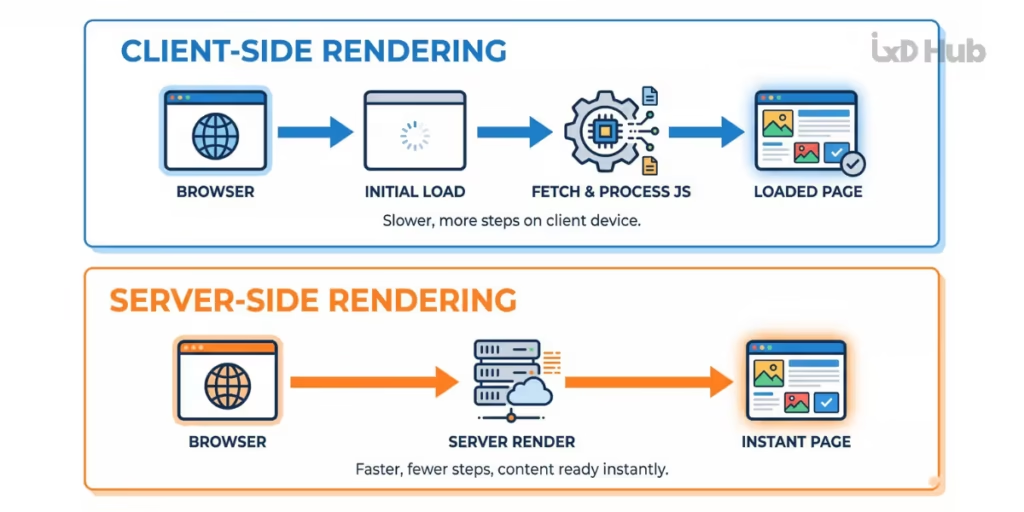
The primary technical divide between a standalone React SPA and a Next.js application lies in where and when the HTML is generated.
| Client-Side Rendering (React SPA) | |
| Browser Requests Page | ──> Server Returns Blank HTML (<div id=”root”>) + Huge JS Bundle |
| ──> Browser Downloads & Executes JavaScript | |
| ──> Browser Fetches API Data ──> UI Finally Renders | |
| Server-Side Rendering (Next.js SSR) | ──> Server Fetches Data & Renders Full HTML |
| ──> Server Returns Fully Populated HTML (Instant Paint) | |
| ──> Browser Hydrates Page (Attaches Event Handlers) | |
1. Client-Side Rendering (CSR) in React SPAs
In a standard React application (typically built with Vite), the server returns a nearly empty HTML shell containing a single root <div> and a bundle of compiled JavaScript files.
The user’s browser downloads the JavaScript bundle, executes the code, initializes the virtual DOM, sends API requests to your backend database, and finally paints the UI elements on the screen.
- The Advantage: Once the initial bundle loads, navigating between internal views is instantaneous because no additional HTML pages need to be requested from a server. State transitions feel snappy, and hosting requires nothing more than an inexpensive Amazon S3 bucket or CDN edge cache.
- The Penalty: The First Contentful Paint (FCP) is slow, especially on mobile devices or weaker network connections. Furthermore, search engine crawlers and AI answer engines must execute client-side JavaScript to read your content—a process that is historically inconsistent and prone to indexing errors.
2. Server-Side Rendering (SSR) & React Server Components (RSC) in Next.js
Next.js shifts the rendering workload to the server. When a user or search bot requests a URL, the server executes the React code, retrieves the required data directly from your database or APIs, renders the complete HTML layout, and streams it back to the client.
- The Advantage: The browser receives fully populated HTML immediately. The user sees text, pricing tables, and layouts without waiting for heavy client bundles to parse. This is critical for optimizing Core Web Vitals (Largest Contentful Paint)—a primary factor in Internal link: How to Improve Website Speed and Performance for Better UX—and ensuring clean data extraction by search crawlers.
- The Complexity: Server rendering introduces architectural overhead. You must run a Node.js server environment (or serverless edge functions), manage server-side caching policies, and handle hydration—the process where the browser attaches JavaScript event listeners to the pre-rendered HTML. If your server-rendered HTML does not match what the client executes, React throws hydration mismatch warnings that degrade performance.
For early-stage SaaS applications, state management also branches based on this choice. Managing state across server and client boundaries in Next.js requires a clear separation between transient UI states and cached server responses. To see how to structure this without over-engineering your frontend, explore our guide on Internal link: React State Simplified: When to Use Props, Context, or Redux.
The Founder’s Business Impact Matrix
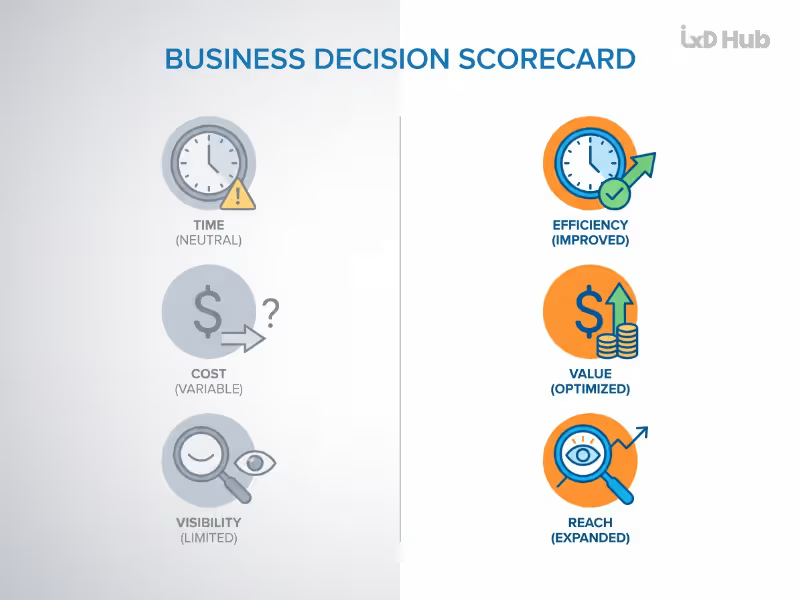
Technical architecture decisions directly affect your business metrics. Here is how React SPAs and Next.js compare across the four core dimensions of SaaS operations.
| BUSINESS IMPACT COMPARISON | ||
| Business Metric | React SPA (Vite / CRA) | Next.js (App Router) |
| Time-to-Market | Slower (custom routing/tooling) | Faster (batteries-included stack) |
| Hosting / Infra | Ultra-low ($5–$20/mo static) | Moderate ($20–$150+/mo serverless) |
| Organic SEO & AEO | Poor / High friction | Excellent / Built-in |
| Hiring Pool | Broadest (standard JS/React) | Large (standardizing rapidly) |
| Long-Term Debt | High if public pages grow | Low for multi-surface SaaS apps |
1. Speed to MVP & Time-to-Market
In an early-stage startup, speed of iteration is your only competitive moat.
- With a React SPA: Your engineering team must make dozens of scaffolding decisions before writing their first business logic feature. They must choose, configure, and maintain libraries for client-side routing (React Router), head metadata management (React Helmet), code-splitting, asset bundling, and environment configuration.
- With Next.js: Routing, build optimization, image compression, environment separation, and API scaffolding are standardized out of the box. A small engineering team can build both the public marketing pages and the core application dashboard within a single monorepo using unified TypeScript types.
The Takeaway: Next.js eliminates 3 to 6 weeks of initial architectural scaffolding, allowing founders to validate product-market fit faster.
2. Search Engine Optimization (SEO) & AI Answer Engine (AEO) Viability
How your SaaS acquires customers dictates your technical architecture.
- If your go-to-market strategy relies on outbound sales, direct partnerships, or closed product demos, public search visibility is secondary. A React SPA running behind an authentication wall (
app.yourdomain.com) is completely adequate. - If your product relies on organic inbound traffic, programmatic SEO, comparison pages, public feature documentation, or directory listings, a client-rendered React SPA introduces serious growth bottlenecks.
Google has improved its ability to crawl JavaScript, but client-rendered SPAs frequently suffer from rendering timeouts and delayed indexing. More importantly, modern AI Answer Engines (like Perplexity, ChatGPT Search, and Google AI Overviews) rely on rapid, high-density HTML passage extraction. As we explored in our strategic breakdown of Internal link: SEO, GEO, AIO, AEO & SXO: The New Layers of Web Search, if your pricing or feature details are locked inside client-side bundles, LLMs will fail to parse and cite your product data accurately.
The Takeaway: For content-led or product-led growth (PLG) SaaS models, Next.js server-side rendering is practically mandatory.
3. Cloud Infrastructure & Hosting Economics
Cost predictability matters when managing early-stage runway.
| Hosting Architecture | |
| React SPA | [AWS S3 / Cloudflare Pages] ──> Fixed, predictable cost ($0–$15/month) |
| Next.js App | [Vercel / AWS ECS / Node.js] ──> Serverless execution / compute costs |
- React SPAs: Consist entirely of static assets (HTML, JS, CSS, images). They can be deployed globally across CDNs like Cloudflare Pages, AWS CloudFront, or Netlify for virtually zero cost, handling massive traffic spikes without compute charges.
- Next.js Applications: Require an active compute layer to execute server-side functions and Server Components on demand. While platforms like Vercel make deployments effortless, serverless compute functions, bandwidth overages, and image optimization pipelines can lead to unexpected billing increases as traffic scales.
The Takeaway: If your MVP has zero budget for dynamic server compute, a React SPA on static hosting is cheaper. However, for most SaaS startups, Next.js self-hosted on AWS ECS, Docker containers, or modest Vercel tiers remains a tiny fraction of overall operational spend.
4. Developer Hiring & Team Velocity
React remains the most widely adopted UI library globally. Finding frontend engineers who understand core React components, hooks, and props is straightforward.
Next.js has become the de facto enterprise standard for production React. While junior developers may occasionally struggle with App Router caching semantics, Server Actions, or edge runtime limitations, modern full-stack engineers are overwhelmingly proficient in Next.js. Adopting Next.js establishes clear architectural conventions across your repository, making it easier to onboard new engineers without debating folder structures or custom bundling scripts.
For a broader evaluation of how modern development stacks compare for growing businesses, read our comprehensive analysis on Internal link: Choosing the Right Website Development Platform.
The Hidden Cost of the “SPA First, Migrate Later” Strategy
A common trap for early-stage founders is saying: “We will build a simple React SPA for our MVP today, and if we need SEO or SSR later, we will migrate to Next.js.”
This assumption underestimates the technical debt of a framework migration.
| Migration Friction Points |
| 1. Routing Overhaul: Migrating imperative React Router to file-based App Router layouts. 2. Window/DOM Access: Refactoring components that unsafely access `window`, `document`, or `localStorage` during SSR lifecycle. 3. Data Fetching Architecture: Rewriting `useEffect` data fetching hooks into asynchronous Server Components or React Query hydration. 4. State Management Refactoring: Decoupling global stores that assume pure client-side execution contexts. |
Retrofitting SSR into a mature client-side React codebase typically takes between 4 to 8 weeks of dedicated senior engineering time—costing anywhere from $15,000 to $40,000 in diverted developer hours.
If there is a reasonable probability that your SaaS will require public programmatic pages, fast social media preview cards, or high-performance landing pages within its first 12 months, building on Next.js from day one eliminates this rewrite penalty entirely.
When a Standalone React SPA Is Actually the Better Choice
Next.js is powerful, but it is not a universal hammer. There are concrete technical scenarios where a standalone React SPA (built with modern tooling like Vite) is the superior architectural choice for an MVP.
| Stick with a Standalone React SPA if your product matches these criteria |
| ├── 1. Purely Authenticated Software (100% behind login, zero public SEO needs) ├── 2. Heavy Real-Time Canvas / WebGL Apps (Figma-like design tools, CAD, complex games) ├── 3. Offline-First Desktop/Mobile Shells (Electron, Tauri, or Capacitor wrappers) └── 4. Decoupled Multi-Service Architecture (Marketing site already on WordPress/Webflow) |
- Pure Behind-the-Login Applications: If your SaaS product is an internal business tool, an analytics dashboard, or an enterprise portal accessible only after authentication, you derive zero value from server-side rendering. A Vite-powered React SPA provides faster local development feedback, zero serverless configuration complexity, and rock-bottom static hosting costs.
- Heavy Client-Side Canvas Applications: If you are building browser-based video editors, CAD tools, interactive data visualizers, or rich node-based canvas editors (like Figma or Miro), 99% of your logic executes directly on the client GPU and WebAssembly layers. Running a server-rendering layer adds architectural overhead without user-facing benefits.
- Completely Decoupled Marketing Stacks: If your marketing team already runs the public marketing website on a dedicated headless CMS or managed platform, and your engineering team is only responsible for the software dashboard at
app.saas.com, an SPA is clean, lightweight, and isolated.
When Next.js Is Mandatory for a SaaS Tech Stack

Conversely, Next.js is the clear industry standard if your SaaS business model relies on any of the following technical requirements:
| Choose Next.js if your product roadmap requires |
| ├── 1. Product-Led Acquisition (Public templates, tools, or user profiles) ├── 2. Programmatic SEO (Automated generation of thousands of indexed pages) ├── 3. Dynamic Social Sharing (Dynamic OpenGraph preview cards for user content) └── 4. Unified Monorepo Operations (Marketing pages, blog, and app in one codebase) |
- Product-Led Growth (PLG) & Public Data: If free users generate content that serves as an acquisition loop (e.g., public forms, dashboards, portfolio links, or shared reports), those pages must load instantly and render full HTML for social scrapers and search bots.
- High-Performance Programmatic SEO: If your growth strategy involves ranking for long-tail search terms across thousands of software integration pages or data comparison directories, Next.js Static Site Generation (SSG) and Incremental Static Regeneration (ISR) allow you to build and update millions of pages automatically without overloading your production databases.
- Unified Full-Stack Velocity: Next.js Route Handlers and Server Actions allow early-stage teams to build backend endpoints, handle Stripe webhooks, and process database mutations directly within their frontend codebase, eliminating the need to maintain a separate Node/Express microservice repository during the validation phase.
Interactive Element: The SaaS MVP Tech Stack Decision Flow
Before committing engineering resources, run your product requirements through this architectural decision framework.
An interactive diagnostic tool that guides founders through 4 key architectural branches: user acquisition model (search/social vs. direct/outbound), rendering location requirements (canvas/heavy client vs. data-driven HTML), infrastructure budget constraints (static hosting vs. serverless compute), and team composition (full-stack vs. dedicated API/FE split) to generate a tailored tech stack recommendation.
| SAAS ARCHITECTURE DECISION TREE |
| Q1: Does your SaaS rely on public search, social previews, or AEO? ├── YES ──> [ NEXT.JS IS MANDATORY ] (SSR/SSG required for discovery) └── NO ──> Proceed to Q2 Q2: Is your application heavily canvas-based, WebGL, or 100% private? ├── YES ──> [ REACT SPA (VITE) ] (Simpler infra, zero server overhead) └── NO ──> Proceed to Q3 Q3: Does your team want a unified monorepo (API + UI in one codebase)? ├── YES ──> [ NEXT.JS FULL-STACK ] (Faster MVP velocity & shared types) └── NO ──> [ REACT SPA + DEDICATED BACKEND ] (Go/Python/Node API) |
Detailed Framework Comparison
| Evaluation Feature | Standalone React SPA (Vite) | Next.js (App Router) | Strategic Business Impact |
| Primary Rendering Mode | Client-Side (CSR) | Hybrid (SSR, SSG, ISR, RSC) | Next.js delivers superior initial paint times and search discoverability. |
| Routing Architecture | Manual (react-router-dom) | Built-in file-system routing | Next.js reduces routing boilerplate and enforces project consistency. |
| Initial Bundle Overhead | High (Entire app bundle downloaded) | Low (Automatic route-based code splitting) | Next.js improves mobile user retention with smaller initial payloads. |
| Data Fetching Pattern | Client-side fetch in useEffect | Async Server Components / Server Actions | Next.js eliminates client-side loading spinners on initial page loads. |
| Backend Integration | Requires separate backend service | Built-in API Route Handlers | Next.js allows full-stack prototyping in a single codebase. |
| Hosting Requirements | Static storage (S3, Cloudflare Pages) | Node.js runtime or Serverless Edge | React SPA offers lower and more predictable hosting overhead. |
| Social Graph Previews | Requires third-party prerendering | Dynamic server-rendered OpenGraph | Next.js generates rich link previews on LinkedIn, X, and Slack out of the box. |
The Recommended Architecture Pattern for 2026
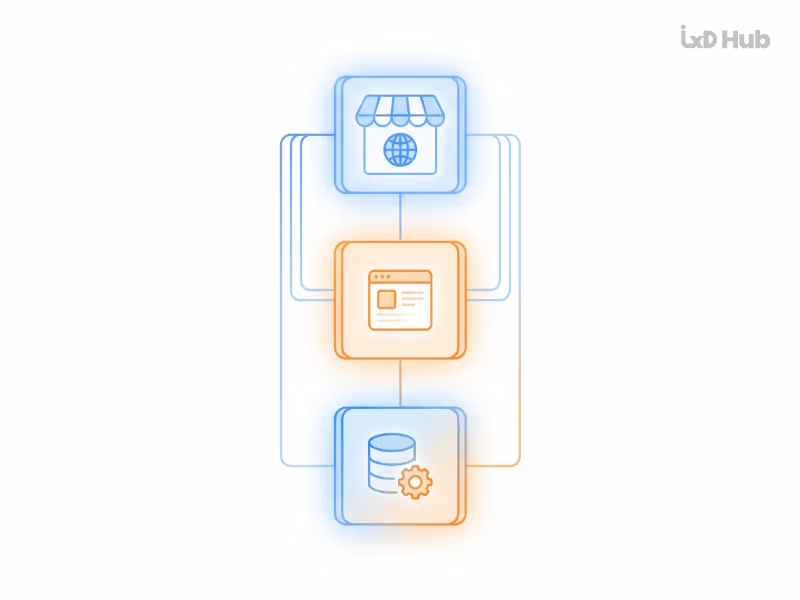
For 90% of scaling SaaS startups, the optimal architectural design is neither “100% SPA” nor “100% Serverless Monolith.” It is a Clean Subdomain Separation:
| Recommended Modern SaaS Topology |
| marketing.yourdomain.com / yourdomain.com └── Powered by NEXT.JS (Optimized for speed, SEO, AEO, and marketing) |
| app.yourdomain.com (The Software Product) └── Powered by NEXT.JS or REACT SPA (Optimized for authenticated UI) |
| api.yourdomain.com (The Core Engine) └── Dedicated Backend Service (Node.js, Go, Python, or Supabase/Postgres) |
By separating your public marketing engine from your private application layer, you ensure that your public site captures search traffic, loads instantly, and operates as a high-intent pipeline engine, while your engineering team maintains complete freedom to optimize the authenticated application for deep interactive workflows.
To explore how high-performance frontend architectures intersect with revenue generation and conversion optimization, explore our work on our Outbound link: Portfolio Page or review our strategic capabilities on our Outbound link: Full Service Digital Agency service page.
Make the Right Architectural Call for Your Runway
Choosing your tech stack is not about chasing developer trends. It is about aligning your technical infrastructure with your business model so you can Learn, Build & Scale without technical debt choking your momentum.
At IxD Hub, we help early-stage founders and technical teams Move Beyond Buzz to build resilient, scalable digital products. We design modern React and Next.js applications engineered for speed, conversion efficiency, and real growth—delivering software architectures that turn inbound traffic into clicks that convert.
If you are currently evaluating your SaaS stack, planning an MVP build, or facing the architectural limits of a legacy frontend, let’s talk through the numbers before you write a single line of code.
👉 Still weighing the trade-offs for your specific product? Connect directly with our technical architects on WhatsApp for a rapid, no-nonsense assessment of your stack requirements.
Prefer a formal technical scoping review? Book an architecture consultation through our Contact Page, and our engineering team will help you evaluate your roadmap.